
Research Papers
Advanced GPS Based Time Linked Calibration with PTB’s New Callibration Setup
Abstract – The PTB has assembled an easy-to-use GPS calibration set-up intended for relative time link calibrations, consisting of a GTR50 time and frequency GPS receiver and an SR620 time-interval counter integrated in a small rack together with a monitor and a keyboard.
Usually, locally available time interval counters are used to measure the offset t0 between the 1 PPS signal representing the local time scale and the signal that is connected to the traveling receiver in each visited laboratory. In each time-interval counter, a distinct error for time-interval measurement shows up. If only one single counter is used at all participating laboratories, this error cancels out, assuming that the properties of this counter do not change during the travel, as it is assumed for the properties of the traveling receiver as well.
Time and Frequency Transfer Using a WAAS Satellite with L1 and L5 Code and Carrier
Abstract— Two Wide Area Augmentation System (WAAS) satellites are now transmitting the standard L1 and L5 carriers and codes of the Global Positioning System (GPS), though with a five times higher data-bit rate. Since these are geostationary satellites, it is possible to aim a parabolic dish at one and obtain high-gain, low-multipath interference signals without interruption. Such high-gain dishes, along with appropriate GPS receivers, were set up at three timing laboratories in North America: the National Institute of Standards and Technology (NIST) in Boulder, Colorado, U.S.A., the United States Naval Observatory (USNO) in Washington D.C., U.S.A., and the National Research Council (NRC) in Ottawa, Ontario, Canada. We report the results of this experiment over a 104 d period:
January 1 to April 14, 2008, though with several significant outages, and other clock/data problems.
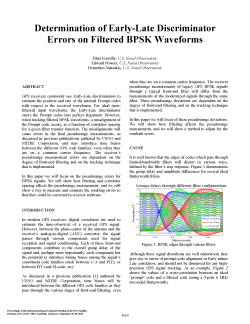
Determination of Early-Late Discrimination of Early-Late Discriminator Errors on Filtered BPSK Waveforms
ABSTRACT – GPS receivers commonly use Early-Late discriminators to estimate the position and rate of the internal Prompt codes with respect to the received waveforms. For ideal (nonfiltered) input waveforms, the Early-Late discriminator steers the Prompt codes into perfect alignment. However, when tracking filtered BPSK waveforms, a misalignment of the Prompt code occurs, as a function of correlator spacing for a given filter transfer function.
Two-Way Satellite Time Transfer Between USNO and PTB
Abstract—Two completely independent two-way time and frequency transfer (TWSTFT) links have been established between the institutions of USNO and PTB, with transponder frequencies in the Ku-band and X-band, respectively. The Kuband link has some strategic importance, since currently it connects almost one half of the atomic clocks in the BIPM network that are employed for the realization of TAI.
ACCOUNTING FOR TIMING BIASES BETWEEN GPS, MODERNIZED GPS, AND GALILEO SIGNALS
Abstract – GPS timing and navigation user solutions are based on pseudorange measurements made by correlating user receiver-generated replica signals with the signals broadcast by the GPS satellites. Any bias resulting from this correlation process within the user receiver tends to be common across all receiver channels when the signal characteristics are identical (code type, modulation type, and bandwidth). Such common biases will cancel in the user navigation solution and appear as a fixed bias for timing solutions. New GPS signals and the future addition of the Galileo system are somewhat different from the legacy signals broadcast by GPS today and new ways of accounting for biases will be needed.
THE ACCURACY OF TWO-WAY SATELLITE TIME TRANSFER CALIBRATIONS
Abstract – Results from successive calibrations of Two-Way Satellite Time and Frequency Transfer (TWSTFT) operational equipment at USNO and five remote stations using portable TWSTFT equipment are analyzed for internal and external errors, finding an average random error of ±0.35 ns, an average type-B uncertainty of ±0.15 ns, and an average total error of ±0.38 ns for a single calibration measurement over time spans of up to 4.9 years. Closure discrepancies suggest that the operational apparatus is at least as good as the calibration equipment.
GPS + Modernized GPS + Galileo – Signal Timing Biases
by: Chris Hegarty, MITRE Corporation, and Ed Powers and Blair Fonville, United States Naval Observatory
GPS TIMING AND NAVIGATION USER SOLUTIONS ARE BASED ON PSEUDORANGE MEASUREMENTS MADE by correlating user-receiver–generated replica signals with the signals broadcast by the GPS satellites. Any bias resulting from this correlation process within a user receiver tends to be common across all receiver channels when the signal characteristics — code type, modulation type, and bandwidth — are identical. Such common biases will cancel out in the user navigation solution and appear as a fixed bias for timing solutions and some atmospheric signal analyses. New GPS signals and the future Galileo signals are somewhat different than the legacy signals broadcast by GPS satellites today, so new ways of accounting for biases will be needed.
Continued Evaluation of Carrier phase GNSS Timing Receivers for UTC TAI Applications
Abstract – USNO previously evaluated several carrier-phase GNSS timing receivers to determine their suitability to support UTC/TAI applications. These receivers were subjected to thermal testing, power cycle retrace testing, and mid-term stability evaluation. Two receivers showed poor performance during these tests. Newer versions of these receivers were released and have been reevaluated. Test results are reported in this paper.